Frieren: Beyond Journey's End
TV202315 epsFinished
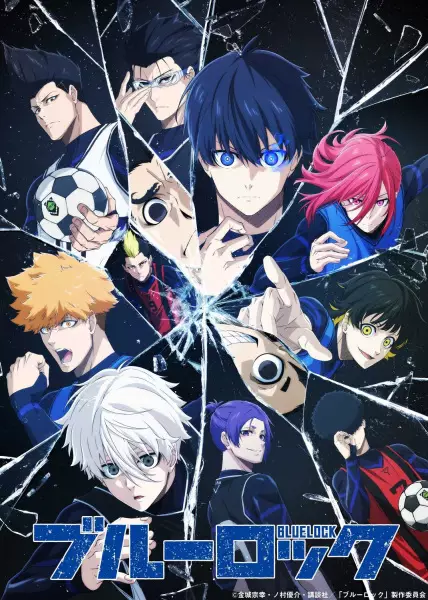
This Aniwatch Blue Lock guide is a sports-anime catalog page with selected episode guides and a focus on tournament pressure, striker psychology, and team conflict.
Sports-anime fans can use this page to follow the competition beats, compare match pressure, and jump between selected episode guides quickly.
Elite young forwards are locked inside a ruthless training project designed to create one fearless striker. Soccer becomes a psychological contest where ego, vision, and risk matter as much as skill.
Blue Lock is a football anime that opens by arguing football anime have been getting it wrong. Adapted by Studio 8bit in 2022 from the manga written by Muneyuki Kaneshiro with art by Yusuke Nomura, it takes the genre's usual message about teamwork and passing and deliberately sets it on fire.
The setup is a reaction to a real national frustration. After Japan's underwhelming exit from the 2018 World Cup, the Japan Football Union hires an eccentric coach named Jinpachi Ego with a single mandate: produce a striker capable of winning a World Cup. His method is Blue Lock, a sealed facility where three hundred of the country's most promising young forwards are locked in and forced to compete against each other for survival.
Ego's thesis is that Japan has produced excellent midfielders and defenders and no world-class egoist, because the entire youth system trains players to pass rather than to want the goal for themselves. His fix is brutal. Anyone eliminated from Blue Lock is permanently banned from the national team, which turns every drill into an existential threat.
Yoichi Isagi enters the programme immediately after a defining failure. In the match that ends his high school career he passes to a more celebrated teammate instead of shooting, and they lose. That single decision, replayed and re-examined, becomes the spine of the series. Blue Lock is less about football tactics than about a question the sport rarely asks out loud: what does it cost to become someone who takes the shot?
Isagi is an unusual sports protagonist because his talent is analytical rather than physical. He reads space, models where the ball will be several moves ahead, and adjusts. The series visualises this as a field of shifting geometry, which makes his thinking legible rather than something we are simply told about.
Meguru Bachira is his opposite and his catalyst, a dribbler who plays alongside an imaginary monster he has spoken to since childhood and who latches onto Isagi as the first person who does not find that strange. Rensuke Kunigami brings raw shooting power and the most conventional sporting decency in the cast, which the show uses to interrogate whether decency is an asset here at all. Hyoma Chigiri is a former prodigy whose knee injury left him afraid of his own speed.
Later arrivals raise the ceiling considerably. Seishiro Nagi treats extraordinary talent as an inconvenience because effort bores him, and Ryusei Shidou is a genuine predator whose only interest is the goal itself.
Studio 8bit leans into a visual grammar borrowed from horror and shonen battle series rather than traditional sports storytelling. Eyes glow, monsters appear behind players, and moments of insight are staged like power awakenings. Purists occasionally object, but it is a coherent choice: this is a series about internal psychology, so it externalises psychology.
The ranking system does a lot of structural work too. Because every player has a visible number and a visible position on the board, the stakes never need explaining. You always know exactly who is close to elimination, and the show can generate tension from a training exercise as effectively as from a match.
The series is smarter about selfishness than its marketing suggests. Ego is not arguing that teamwork is worthless. He is arguing that a striker who defers is useless, and that Japanese football has confused politeness with cooperation. The distinction matters, and the show keeps testing it.
What keeps it from becoming simple provocation is that Blue Lock repeatedly demonstrates that pure selfishness loses too. Players who refuse to combine get isolated and eliminated. The synthesis Isagi keeps circling is harder than either extreme: use others deliberately, in service of your own finish, and accept that they are doing the same to you.
You do not need to like football to enjoy Blue Lock, and plenty of its audience does not follow the sport at all. If you enjoy tournament structures, elimination stakes, and characters whose psychology is the actual battlefield, it works regardless of your interest in the game.
It is a poor fit if you want realistic sports drama or a warm story about friendship through athletics. Blue Lock is loud, stylised, and cheerfully mean to its cast. That is the appeal, but it is not for everyone.
The first season covers the initial selection phase and the team-based Second Selection, introducing the core cast and establishing the elimination format. It ends mid-competition rather than at a natural conclusion, which is standard for the series' structure.
Watch in release order. The franchise also includes a spin-off focused on Seishiro Nagi's backstory, but it is designed to be read or watched after you already know who he is, so it should not be your starting point.
Jujutsu Kaisen shares Blue Lock's appetite for high-pressure tournament structures and characters who improve by being pushed to breaking point, and its cursed-technique battles reward the same kind of tactical reading Isagi does with space.
Chainsaw Man matches its willingness to be abrasive and its refusal to let characters be straightforwardly likeable. If you want the competitive escalation without the aggression, Solo Leveling delivers a similar ladder-climbing structure with a single protagonist rather than an ensemble.
No. The series explains every tactical concept it uses, and its real subject is psychology rather than technical football. Many viewers come to it with no interest in the sport.
The first season runs twenty-four episodes, covering the First and Second Selection phases of the Blue Lock programme.
Not quite. Ego argues that strikers specifically must be selfish, and the series repeatedly shows that players who refuse to combine with others get eliminated. The message is more nuanced than the premise suggests.
Yoichi Isagi, a forward whose defining strength is spatial awareness rather than speed or power. The story follows his attempt to develop a weapon that makes him worth selecting.
Only superficially. Both of those celebrate team chemistry, while Blue Lock is built around elimination and individual ambition. Tonally it sits closer to a battle shonen than a traditional sports series.