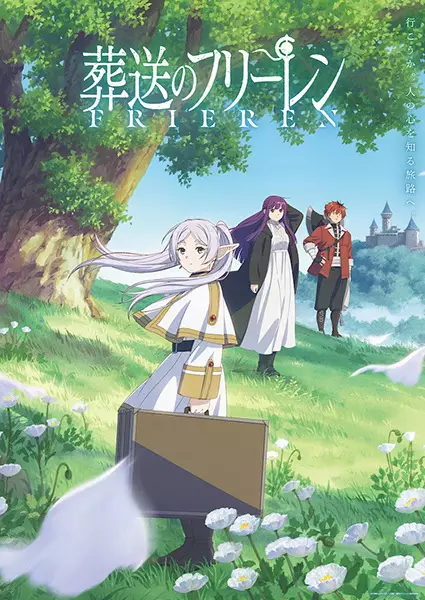
Frieren: Beyond Journey's End
TV202315 epsFinished
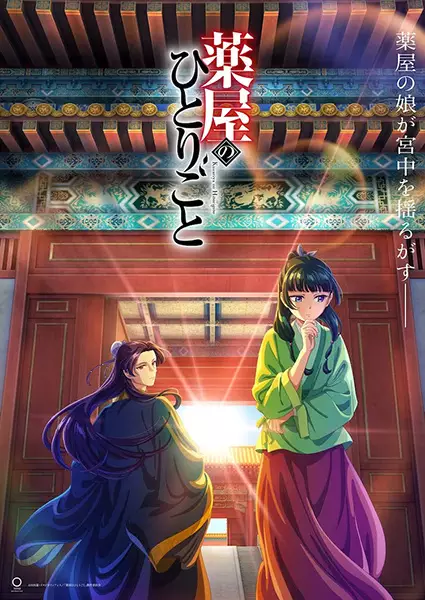
This Aniwatch guide for The Apothecary Diaries presents a mystery-drama page with selected episode navigation and helpful series details.
The description focuses on palace intrigue, medical deduction, character wit, and historical atmosphere. Each episode page is phrased uniquely so the site has its own editorial voice.
A sharp apothecary is forced into palace service, where her curiosity turns illness, rumor, and court politics into solvable mysteries. Her calm eye for detail makes every case feel dangerous and clever.
The Apothecary Diaries is a mystery series disguised as a court drama, adapted by TOHO Animation Studio and OLM in 2023 from Natsu Hyuuga's light novels. It became one of that year's standout successes largely on the strength of a protagonist who is far more interesting than the genre usually allows.
The setting is a fictional imperial palace modelled loosely on imperial China. Maomao is a young apothecary from the pleasure district, raised among medicines and poisons by her adoptive father Luomen, who is kidnapped and sold into service as a lowly servant in the rear palace. Her plan is simple: keep her head down, serve out her term, and go home.
That plan lasts until Maomao overhears that two of the Emperor's infant children have fallen ill and one has died. She recognises the symptoms as lead poisoning from face powder, and she cannot help herself. She leaves an anonymous warning, and the palace's enigmatic eunuch official Jinshi traces it back to her immediately.
From there she is promoted into the service of one of the imperial consorts, and the series settles into a structure of self-contained mysteries connected by a slowly developing larger plot. Poisonings, mysterious illnesses, apparent hauntings and court intrigues all pass across her desk, and almost all of them resolve through pharmacology, observation, or an understanding of how people behave when they want something.
Maomao is the reason the series works. She is pragmatic to the point of bluntness, entirely uninterested in palace status games, and possessed of an alarming enthusiasm for poisons that she cheerfully tests on herself. Her arms are scarred from self-experimentation, which the series plays as a running joke and a genuine character detail.
Jinshi is beautiful, universally adored, and profoundly frustrated that Maomao treats him as an inconvenient obstacle rather than an object of desire. Their dynamic is the series' slow-burning engine, built almost entirely on her refusal to react the way everyone else does.
The consorts are given real interiority rather than being reduced to rivals. Gyokuyou is warm and politically astute, Lihua's grief is treated with genuine weight, and the rear palace itself is presented as a system that constrains everyone inside it, including the people who appear to benefit.
Most episodes present a problem with a concrete, physical explanation. The series plays fair: the information needed to solve each case is shown to the audience, and Maomao's reasoning is laid out clearly enough to follow rather than delivered as a conclusion from nowhere.
What elevates it is that the solutions are usually rooted in real historical pharmacology and toxicology. Lead cosmetics, mercury, medicinal herbs and food preparation all feature accurately, which gives the mysteries a texture that invented magic systems cannot provide. The larger palace plot advances gradually underneath these standalone cases.
The series is quietly about who is permitted to be knowledgeable. Maomao's expertise came from the pleasure district rather than formal education, and her position as a servant means her conclusions are frequently dismissed until someone powerful chooses to listen.
It is also honest about the rear palace as an institution. The consorts and servants are confined, competing for the attention of one man, and the series presents this as a structural cruelty rather than romantic backdrop. Maomao's detachment from that competition is what allows her to see the place clearly.
If you like procedural mysteries, historical settings, and protagonists driven by intellectual curiosity rather than ambition or revenge, The Apothecary Diaries is an easy recommendation. Its slow-burn romantic thread rewards patience without ever dominating the story.
It is a weaker fit if you want action or fast plot progression. There are no fights, the pace is deliberate, and much of the tension is conversational. Viewers looking for spectacle will find little here.
The first season aired across two cours, twenty-four episodes total, adapting the early light novel volumes and establishing both the episodic mystery format and the longer palace plot.
Watch in release order. The light novels and two separate manga adaptations continue well beyond the anime, so the season ends at a natural pause rather than a conclusion.
Frieren: Beyond Journey's End shares its patient pacing and its focus on a protagonist defined by curiosity, though it trades court intrigue for a fantasy road story about memory and grief.
Demon Slayer: Kimetsu no Yaiba offers a comparable historical atmosphere with action in place of mystery. Spy x Family matches its blend of episodic problem-solving with an ongoing plot and a slow-developing central relationship.
There is a slow-burn romantic thread between Maomao and Jinshi, but the series is primarily an episodic mystery. The romance develops gradually in the background rather than driving the plot.
The first season ran twenty-four episodes across two cours, adapting the early light novel volumes.
The setting is a fictional empire inspired by imperial China rather than a specific historical period. The pharmacology and toxicology, however, are largely grounded in real historical practice.
No. The anime adapts the story from the beginning and works as a complete entry point. The novels continue well past where the anime currently stops.
Largely yes, though it deals with adult subject matter including the pleasure district, court politics and poisoning. There is minimal violence and no graphic content.